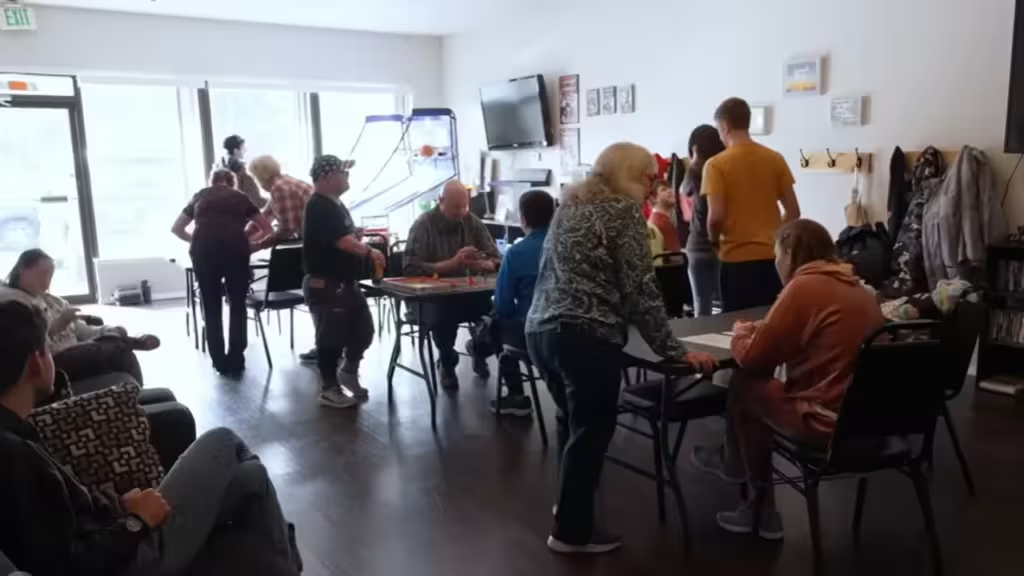
Students will explore how belonging goes beyond simply being present in a group. Through a collaborative innovation challenge, students will learn that belonging happens when everyone’s ideas are valued, every voice is heard, and each person has a meaningful role to play in the success of the group.
Belonging means more than being part of a group. It means knowing that your voice matters and that you contribute something important.
Have you ever been part of a group where you felt included and valued?
What are some ways people can unintentionally make others feel left out?
Kindness 101 Video
Discussion Prompts
How did the people in the video help others feel like they belonged?
What is the difference between being included and truly belonging?
Why is it important for everyone to feel valued in a group?
How can listening to different perspectives make a group stronger?
What can we do when we notice someone being left out?
Activity Materials
Paper for planning
Writing utensils
Activity: Invent the Impossible
Tell students that they have a challenge. The challenge is to create a brand-new invention, business, or service that has never existed before. It should solve a problem at school, at home, or in the world. Possible examples:
Homework Helper Drone
Friendship Finder App
Lost-and-Found Detectives
Stress-B-Gone Backpack
Kindness Delivery Service
In the process, they must create the following for their invention:
A name
What it does
Why people need it
A demonstration or commercial
Students will complete this in rounds.
Round 1: Create
Divide students into groups of 4-6.
Give groups approximately two minutes to begin creating their invention.
Observe but do not intervene.
Pause #1: The Inclusion Check
Stop the activity and ask students to raise their hand if they have shared at least one idea in their group. Often, some students will not raise their hands.
Tell the students that before they can continue, every person in their group must share at least one idea
To promote inclusion, encourage students to use these sentence starters:
“We haven’t heard from everyone yet.”
“What do you think?”
“Would you add anything?”
“Do you have a different idea?”
“What would make this even better?”
Round 2: Improve
Allow the groups several more minutes to continue.
Add a new requirement that their invention now needs a role for every team member. Share possible roles:
Designer
Advertiser
Tester
Inventor
Customer Support
Demonstrator
Pause #2: The Belonging Test
Ask students if everyone has a job. Most groups will say yes.
Then ask the students, “Would the project still work if one person’s role disappeared?”
If the answer is yes, explain that that person may be included, but they are not fully essential to the group yet. Challenge students to redesign their project so every role contributes meaningfully to the group’s success.
Round 3: The Refine Challenge
Before finishing, the team must seek out feedback from every team member. Provide sentence stems:
“What haven’t we thought about yet?”
“What’s your opinion?”
“Would you change anything?”
“What idea should we add?”
“Can you build on this idea?”
Use the feedback to make final edits of the project.
Have the groups present their invention to the class. Remind students that every person must participate. Participation may include:
Speaking
Demonstrating
Acting
Explaining their role
Answering questions
Process the activity by discussing the following questions:
What made your invention stronger?
Did everyone get a chance to contribute?
Was there anyone whose idea changed the project?
What’s the difference between being present and belonging?
How can we tell when someone isn’t included?
What are some small ways we can invite others in?
Share with students that belonging doesn’t happen by accident. Someone has to notice who hasn’t spoken, who doesn’t have a role, or whose ideas haven’t been heard. The strongest groups aren’t the ones with the smartest ideas. They’re the ones that make sure everyone matters.
Continue the Conversation
Why do people sometimes feel left out even when they are part of a group?
How can we help quieter people feel comfortable sharing their ideas?
What makes someone feel valued and respected?
Why are groups stronger when everyone contributes?
How can we create a greater sense of belonging in our school and community?
Journal Prompts
K-5
Describe a time when you felt like you belonged.
What can you do to help someone feel included?
Why is it important to listen to everyone’s ideas?
6-12
Reflect on a time when you felt your voice mattered in a group.
What is the difference between being included and experiencing true belonging?
How can leaders create an environment where everyone feels valued?